
Need Key Facts in Seconds? Just ASK
ASK is Logikcull's patented GenAI fact-finding and data synthesis engine that lets you ask natural language questions and get back clear, reliable answers generated directly from your documents. Use it to find critical docs, build timelines and construct a theory of the case when the clock is ticking.

With Logikcull ASK GenAI, you can...
Trust What You Find
We know you won't use black box AI. ASK surfaces the most relevant documents, ranks them, and, importantly, shows you why with evidence and citations directly from the source.

Every answer comes with rationale and supporting citations with links to the originating material.

Control what gets searched. Run queries across your entire project or limit them to specific document sets.

Discover related documents. ASK surfaces semantically similar documents, so each search packs a punch and you can identify "like kinds."
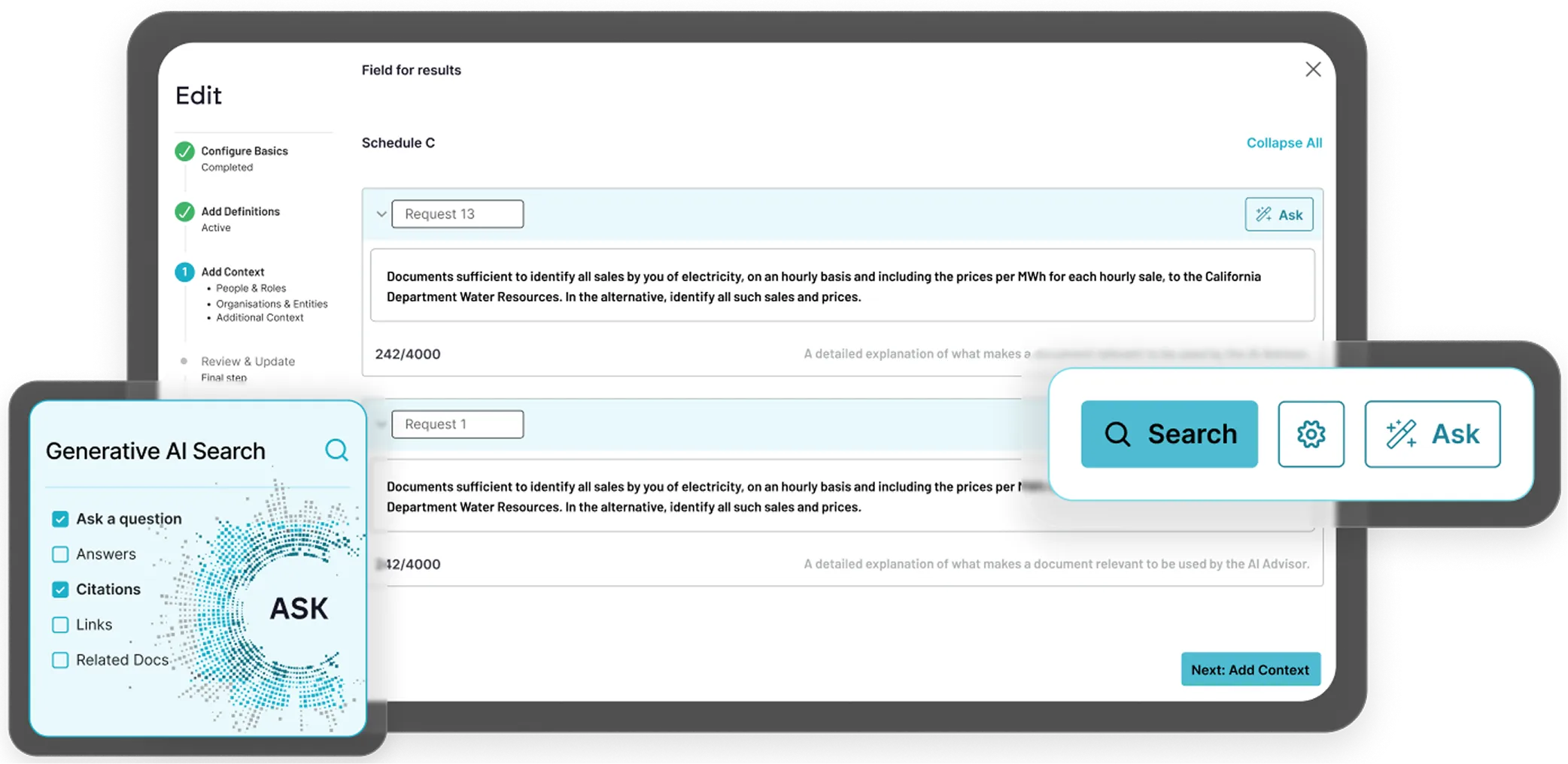
Designed for your most common matters, Logikcull was built for powerful simplicity—and incorporates Reveal’s best-in-class GenAI in a way you can actually use.
Get to the Heart of the Matter
The beating heart of your case strategy shouldn’t stay buried under unresponsive data; the right tools can find the pulse quickly.

Build context-aware narratives. Synthesize the most relevant documents into easy-to-read responses while surfacing up to 100 similar documents for comprehensive discovery.

ASK retrieves docs intelligently, ranking results by relevance to surface the most pertinent information from your case documents.

Get the context and meaning. ASK interprets your query using semantic expansion to understand true intent, going beyond simple keyword matching.
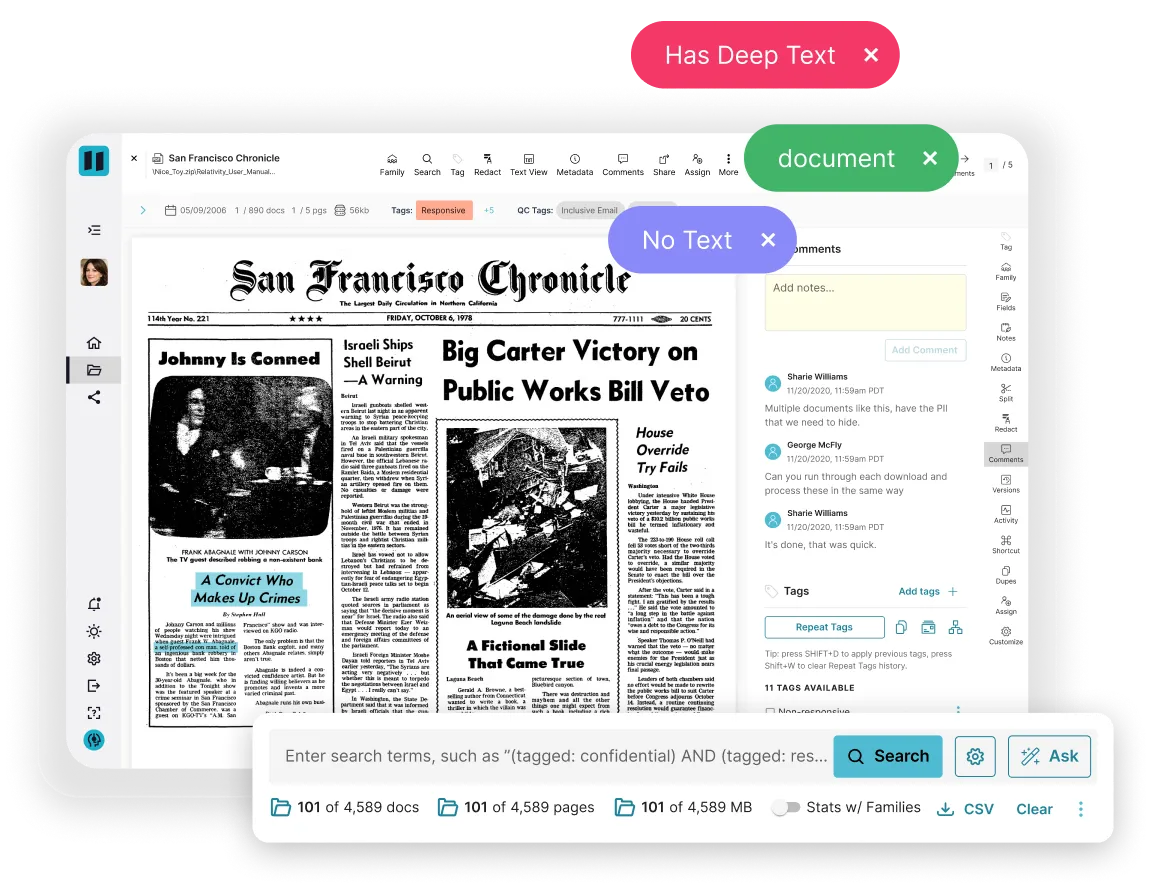
Logikcull is underpinned by GenAI that Reveal customers, including some of the largest law firms and global advisories, have honed in some of the highest-stakes matters.
Make More Assured Decisions
By combining GenAI with document grounding and traceability, ASK enables faster insight, deeper understanding, and more confident decision-
making.

ASK helps teams quickly understand the facts, themes, and key actors across large document sets, informing legal strategy with evidence-backed answers and citations.

ASK accelerates ECA by enabling natural-language questions that surface relevant documents, timelines, and insights early, reducing uncertainty, cost, and time to decision.

ASK augments review by delivering defensible answers with direct citations, links, and related documents, helping reviewers focus on what matters most while maintaining transparency and auditability.
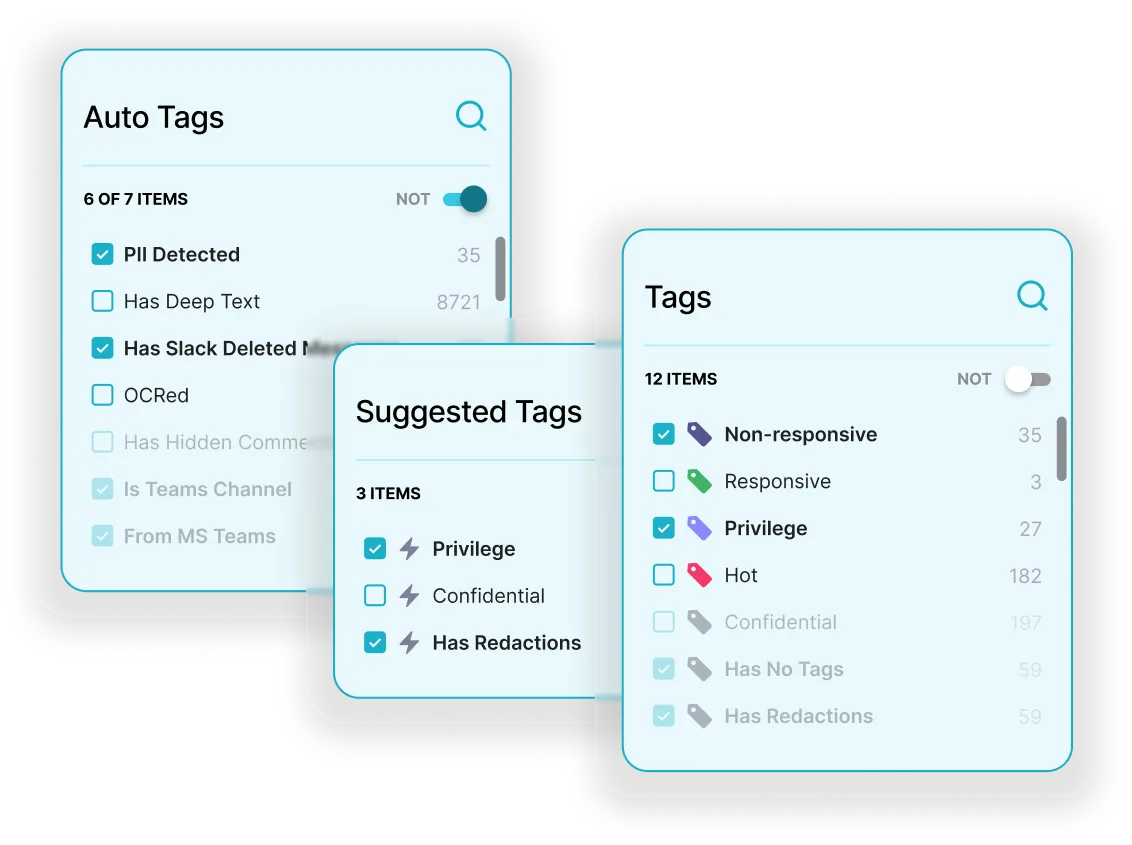
Logikcull prepares your data for ASK smart search by organizing it in a modern system built for speed and context.
Frequently Asked Quesions
All your questions answered
ASK is a patented GenAI fact-finding engine built specifically for legal document review. Instead of writing Boolean search strings, attorneys and legal teams type plain-language questions like "Who knew about the policy change and when?" or "What did the CFO say about the Q3 projections?" and ASK returns a synthesized, cited answer drawn directly from the documents in the matter. Every answer includes rationale, supporting citations, and direct links to the originating documents, so nothing is a black box. ASK also surfaces up to 100 semantically similar documents per query, making each search pack a much bigger punch than a traditional keyword search.
Keyword search finds documents that contain specific terms which is useful, but limited. It requires legal teams to anticipate every word a custodian might have used, and returns a raw list of hits with no synthesis or ranking by relevance. ASK goes further on three dimensions. First, it uses semantic expansion to find conceptually related documents even without exact term matches. Second, it synthesizes results into a readable narrative answer with citations, rather than dumping a list of documents on the reviewer. Third, it ranks results by relevance and surfaces up to 100 related documents per query. The result is faster insight with less manual sifting, and a far lower risk of missing critical evidence buried in non-obvious language.
Semantic search understands the meaning and intent behind a query, not just the specific words used. Traditional keyword search in eDiscovery only finds documents containing the exact terms searched. If a custodian wrote "the numbers look off" instead of "financial fraud," a keyword search misses it. ASK uses semantic expansion to interpret true intent, surfacing conceptually relevant documents even when they don't share the exact vocabulary of the query. For legal teams, this means fewer missed hot documents, less reliance on exhaustive keyword lists, and faster, more complete early case assessment.
Yes, when the AI is transparent, verifiable, and auditable. Courts have increasingly accepted AI-assisted review, including technology-assisted review (TAR) and predictive coding, as defensible when the producing party can explain and document the process. ASK is designed with defensibility in mind: every answer includes cited source documents with direct links, all queries and results are logged, and legal teams can control exactly which document sets ASK searches. There is no black-box output, only evidence-backed answers that attorneys can review, verify, and stand behind in court.
Yes. Legal teams can run ASK queries across an entire project or scope them to a specific document set, such as a filtered subset of custodians, date ranges, or tagged documents. This control is important for proportionality, privilege management, and ensuring ASK is querying the right corpus for each question. For example, teams can isolate ASK to already-reviewed and tagged responsive documents when building a case narrative, or run it across a raw collection during early case assessment to cast the widest net.
Logikcull automatically performs OCR (optical character recognition) on scanned documents, image-only PDFs, and other files without selectable text during the processing stage. This converts them into fully searchable, indexed content, making them available to ASK alongside native electronic files. Logikcull's processing pipeline also flags documents with OCR exceptions or processing errors, so legal teams know if any files could not be fully extracted. The result is a complete, searchable corpus that includes handwritten notes, faxes, and legacy scanned records, not just born-digital documents.
No. ASK operates on a document-grounded, matter-specific basis so it queries the documents in your matter and generates responses from that corpus only. Client data uploaded to Logikcull is not used to train or fine-tune the underlying AI model, and is not shared across matters or customers. This is a non-negotiable requirement for legal data given attorney-client privilege, confidentiality obligations, and ethical rules governing client information. Logikcull's SOC 2 Type II-certified, AES-256 encrypted infrastructure ensures that matter data stays isolated and protected throughout the entire workflow.
No. ASK is designed for everyday legal use without any technical expertise. Attorneys, paralegals, and legal ops professionals type questions in plain English, the same way they'd ask a colleague, and receive cited answers. There's no need to learn Boolean syntax, configure search parameters, or understand the underlying AI architecture. Logikcull prepares and organizes uploaded data for ASK automatically, so teams can start asking questions as soon as their documents are processed. As one Logikcull attorney put it: ASK gives solo practitioners the ability to compete with larger firms without adding headcount or specialized staff.
Early case assessment (ECA) requires quickly understanding the key facts, custodians, timelines, and risk exposure of a matter, ideally before committing to full-scale review. Traditionally this involves manual sampling, keyword searches, and hours of attorney time. ASK compresses ECA dramatically by letting legal teams ask specific factual questions of the entire document set immediately after processing like, "What was the sequence of events leading up to the termination?" or "Which executives were copied on communications about the product recall?", and receive synthesized, evidence-backed answers in seconds. Teams can identify the hot documents, key actors, and critical timelines in minutes rather than days, enabling faster and better-informed decisions about strategy, settlement, and scope.
Yes. ASK is well-suited to any fact-finding scenario where legal teams need to quickly understand what happened, who was involved, and what the documents show. This includes internal HR investigations (answering the 5 Ws before deciding on action), regulatory inquiries (quickly scoping what was known and when), M&A due diligence (surfacing risk factors across large contract or communication sets), and subpoena response (identifying what's responsive without full linear review). Any matter where speed, accuracy, and verifiable answers matter is a fit for ASK.
It helps save time, money and stress. Thanks to Logikcull, all of the company's e-discovery projects and investigations are done in-house, by me."


Katie Lynch
Director of Legal Support, Veolia North
Logikcull enables me to compete with larger firms and gives me a significant advantage”


Robin Ladd
Attorney, Haynes and Boone
We have an obligation as lawyers to stay abreast and one step ahead, and Logikcull helps us do that.”


David Slarskey
David Slarskey, Slarskey LLC
Why Teams Choose Logikcull


Teams choose Logikcull because questions turn into answers instantly, sources are always visible, and complex case data becomes accessible in seconds.
Everything happens directly inside Logikcull, so legal teams can move from early case assessment to deeper issue analysis without switching tools, writing complex searches, or second-guessing results.
The result? An eDiscovery workflow that’s transparent, strategic, and built for the way modern legal teams actually work.
See ASK in Action
You no longer have to choose between simplicity and sophistication. With Logikcull, you get both.
Simple eDiscovery. Real AI.