
The End of Sanctions
How rule revisions and growing expertise are “de-risking” eDiscovery


Executive Summary: The End of Sanctions and the De-risking of eDiscovery
The 2015 amendments to the Federal Rules of Civil Procedure have drastically reduced the risk of spoliation sanctions, creating an environment where the threat of incurring liability through the handling of traditionally risky discovery processes is significantly diminished.
- Spoliation sanctions have declined by 35%
- The severest sanctions are denied in 4 out of 5 cases
- Only one in every 8,000 federal civil court cases involves motions for spoliation sanctions
The result is a ‘de-risking’ of eDiscovery, allowing practitioners to bring more of the discovery process in house, without the fear that has long accompanied eDiscovery practice. Read on to find out why.
eDiscovery Without Fear
Are we seeing the end of eDiscovery sanctions? The data indicates a powerful trend in that direction. In the years since the amendment of Rule 37(e) of the Federal Rules of Civil Procedure in December 2015, the number of federal cases involving spoliation sanctions has plummeted.
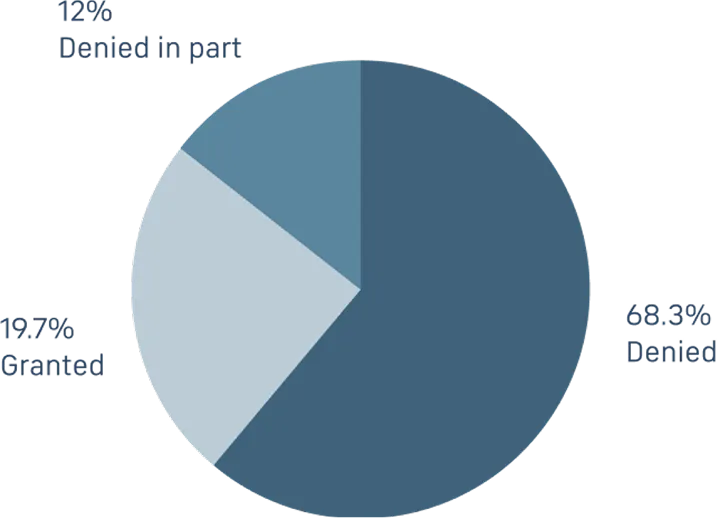
Exhaustive research conducted by Logikcull shows that court issuance of spoliation sanctions has decreased by 35 percent from their height in 2014. Since 2016, more than three out of every four 37(e) sanctions motions have been denied. Such motions are, on average, denied in whole or in part in 76 percent of cases. When the stakes are the highest and the most severe sanctions are at issue, those motions were denied in whole or in part in 82 percent of cases in 2018.
This decline in sanctions, combined with a small but significant growth in the bar’s technology expertise overall and the emergence of easier-to-use discovery tools, is leading to broad adoption of “do it yourself” discovery practices, where incurring liability through the handling of traditionally risky discovery processes is far less of a concern.
The end result is a ‘de-risking’ of eDiscovery, allowing practitioners to bring more of the discovery process in house, without the fear that has long accompanied eDiscovery practice.”
The end result, we posit, is a “de-risking” of eDiscovery, allowing practitioners- whether corporate legal departments, small firms, or their Big Law counterparts- to bring more of the discovery process in-house, without the fear that has long accompanied eDiscovery practice. This change, too, has allowed corporate legal departments to focus on other imperatives, from cybersecurity to GDPR, while realizing significant cost savings. In one example, one of the world’s largest companies was able to realize an estimated $7.5 million savings by in-housing much of their eDiscovery work and subsequently reducing data reviewed by outside counsel by 30 percent on average.
The end result is a ‘de-risking’ of eDiscovery, allowing practitioners to bring more of the discovery process in house, without the fear that has long accompanied eDiscovery practice.”
The implications of this change have not been lost on innovation-focused practitioners. “When the amendments were approved, in-house lawyers were ecstatic,” says Mira Edelman, senior corporate counsel at DISH Network. “The new Rule gave us power to influence outside counsel who were more conservative in their approach to preservation. It gave in-house lawyers the legal authority to make decisions that weren’t driven by uncertainty, to focus on creating defensible workflows, and to begin thinking about corporate information governance. It was freeing.”

Sanctions Today: By the Numbers
DECLINE IN SANCTIONS, 2010-2018:
denial rate, in whole or in part, of severe sanctions in 2018
denial rate of Rule 37(e) sanctions, in whole or in part, in all federal civil cases from 2016 through 2018
decline in issuance of spoliation sanctions from 2016 through 2018 compared to their peak in 2014
Approximate rate of federal cases where Rule 37(e) sanctions were granted from 2016 to 2018
DECLINE IN SANCTIONS, 2010-2018:
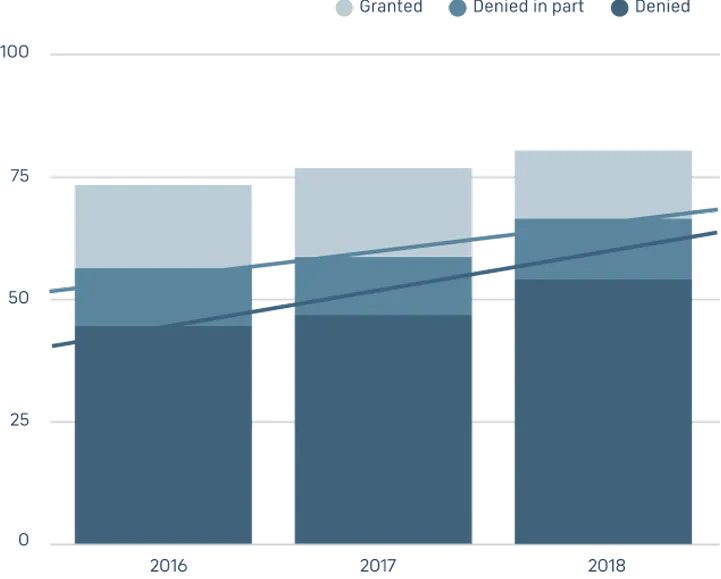
RULE 37 (E) (2) SANCTIONS OUTCOMES, 2016-2018
Methodology
To measure the impact of the 2015 Federal Rules amendments on the issuance of spoliation sanctions, Logikcull analyzed nearly 700 opinions dealing with sanctions for the spoliation of ESI in federal, civil district court litigation, from 2012 through 2018. Those cases were then categorized by the type of sanctions sought. Adverse inferences, adverse jury instructions, dismissal or default judgement, the measures currently reserved to Rule 37(e)(2), were referred to as Rule 37(e)(2) sanctions, regardless of whether that subsection was specifically named.
Other sanctions, such as evidence preclusion or attorneys’ fees, were treated as Rule 37(e)(1) sanctions, for the subsection allowing courts to take “measures no greater than necessary to cure the prejudice.” In most cases, movants sought sanctions allowable under both Rule 37(e)(1) and (e)(2).
The outcomes of each of the 684 relevant opinions were then further tallied, based on whether sanctions motions were denied in whole, granted in part and denied in part, or granted fully. Two past surveys were also consulted to identify historical trends, the Federal Judicial Center’s 2011 study surveying civil cases filed in 19 federal district courts from 2007 to 2008, and the Gibson Dunn year-end electronic discovery updates from 2009 through 2012.
The Rapid Decline in Spoliation Sanctions
The End of Sanctions?
Want to see it in action? Request a demo today
Our team of product specialists will show you how to make Logikcull work for your specific needs and help you save thousands in discovery.