
The Freedom of Information Act: Why 1.5 Million Americans Are Asking Questions
FOIA requests are surging. Learn how agencies use Logikcull to speed records responses, cut backlogs, improve transparency, and meet deadlines.


FOIA requests have nearly doubled since 2022. What does this surge mean for government transparency? For democracy?
“Why are you doing that?” “What is that?” “Who said that?”
If you spend any time around kids, you know they are basically little versions of Joe Sabia, the interviewer for Vogue’s 73 questions series. Kids walk through the world with a sparkling sense of curiosity diligently trying to make sense of the world around them. Peppering any adult with a whole slew of questions, some more insightful than others. One second it’s “What’s your third favorite lizard?” The next it's “Why do people die?”
Annoying? Sometimes, but they are onto something: knowledge is power. Following this logic, if democracies put power in the people’s hands, then knowledge should be there too? That’s precisely what the Freedom of Information Act does.
What is the Freedom of Information Act FOIA?
FOIA is a U.S. federal law that lets you request records from any federal agency. Agencies have to respond unless it falls under exemptions that protect personal privacy, national security, and law enforcement. Anyone can file a FOIA request; there are no citizen or residency requirements. So, a middle schooler in Paris researching U.S.-France relations? They can request State Department meeting minutes. A New York Times reporter? They can request bodycam footage from NYPD. A screenwriter on Abbott Elementary? They can request budget information from the Department of Education.
The process is simple. Fill out a web form, send an email, fax it (if you're feeling retro), mail it in. Just describe what you want in writing and by law you have a right to that information. Agencies are even reporting an increase in automated requests, notably from partisan organizations.
The overarching purpose of this act is to give the public a tool to learn about the government’s actions to make sure the federal agencies are working in the public’s best interests. It's another check and balance to make sure the power stays with the people.
The Path to Free Information
James Madison laid the foundation for FOIA long before anyone dreamed up the acronym. In an 1822 letter to W.T. Barry, he wrote “A popular Government, without popular information, or the means of acquiring it, is but a Prologue to a Farce or a Tragedy; or perhaps both. Knowledge will forever govern ignorance: And people who mean to be their own Governors, must arm themselves with the power which knowledge gives.”
President Madison’s sentiment captures FOIA’s fundamental purpose: empowering citizens with knowledge to prevent democratic failure. Yet it took 133 years for lawmakers to finally get around to championing legislation that matched Madison’s vision.
In 1955 John Moss, a Democratic congressman from California, proposed the FOIA act after the rise of government secrecy during the cold war. He found initial support from newspapers but was meet with hesitations from Republican co-sponsors. It took Moss 12 years and six congressional sessions to successfully get the bill through congress. Ultimately, President Lyndon B. Johnson signed FOIA into law on July 4, 1966 stating, “I sign this measure with a deep sense of pride that the United States is an open society.”
A Living Law: How FOIA Has Evolved
Though powerful in principle, it quickly became apparent that the FOIA lacked the teeth necessary to force government agencies to comply with information requests. The dam broke with Watergate, which made it glaringly apparent that FOIA wasn’t creating any real accountability. In 1974, Congress amended the FOIA into the bill we know today. The overhaul introduced response timeframes, sanctions for wrongly withheld information, and fee waivers for journalists and public interest groups.
Since gaining real teeth in 1974, FOIA has been amended and altered by successive administrations to keep it current and to align with their own agendas. Here's a timeline of notable changes:
- 1976 Sunshine Act opened meetings of multi-member federal agencies to the public
- 1982 Executive Order 12356 signed by President Reagan made it easier to withhold information from FOIA request, this was later reversed.
- 1986 Anti- Drug Abuse Act created special exclusions and altered fee structures
- 1996 Electronic Freedom of Information Act acknowledges the rise of the internet, extending the response deadline from 10 to 20 days, and requiring documents to be available electronically.
- 2001 Executive Order 13233 signed by President George W. Bush increased government secrecy, particularly limiting access to records involving foreign governments.
- 2007 Open Government Act signed by President Bush set strict time limits for responses, barred fees for agency-caused delays, and created FOIA Public Liaisons
- 2016 FOIA Improvement Act signed by President Obama modernized the law for the digital age, requiring agencies to update their FOIA regulations, create a central online request portal, and establish a 25-year limit on withholding information.
The Surge: Why FOIA Requests Are Skyrocketing
Since 2016, there have been no major legislative changes to FOIA, and yearly request volumes remain in the range of 780,000-860,000 requests. Then in 2022, the numbers spiked and they’ve climbed every year since.
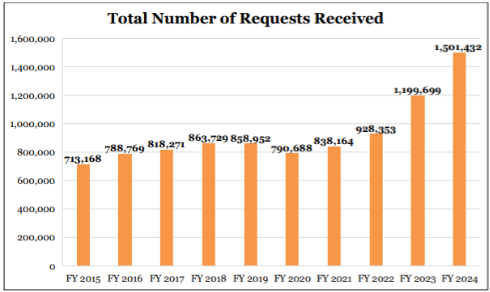
In FY 2024, government agencies:
- Received 1.5 million FOIA requests, a 25% increase from the previous year.
- Saw 92% of agencies receive more requests than in FY23; 43 agencies received more than double their previous year's volume
- Ended the fiscal year with 267,056 backlogged requests
- Processed 27% more expedited requests
- Processed 18% more complex requests, with 73% of complex requests taking longer than 20 days
- Spent $723.4 million on FOIA-related activities, with only 0.34% of costs covered by collected fees
What This Means For Democracy
The state of the Freedom of Information Act tells us a lot about the state of our government at a given time. These across-the-board increases signal the public's growing appetite for transparency and accountability. Yet it's getting harder for government agencies to keep pace, which threatens the democratic pillar FOIA represents. At a certain point (some might argue we’re already there), requests will overwhelm agencies entirely unless we figure out a better way to process these requests.
Across the United States, K-12 school systems, universities, and state and local governments with forward-thinking leaders have risen to meet the challenge. Leveraging tools like Logikcull, they have unlocked bottlenecks, making it possible to meet the 20-day response deadline without breaking a sweat. Logikcull gets them to responsive records quicker, makes redacting simple and speedy, and gets records out the door to requestors at low cost and on deadline. Putting knowledge into the hands of the public, where it belongs.
Learning With Logikcull
Browse our latest resources for innovative legal teams like yours




Stay in the know
Get the latest news, expert guidance, and interviews delivered straight to your inbox so you're always one step ahead.
Get the latest updates
Want to see it work?
Request a demo today.
Managing FOIA requests with limited staff, strict deadlines, and pressure to protect sensitive data?
Logikcull is built for this.