
EDRM 2.0: The Case for Connected eDiscovery
What the EDRM 2.0 Model teaches us about the future of corporate eDiscovery.

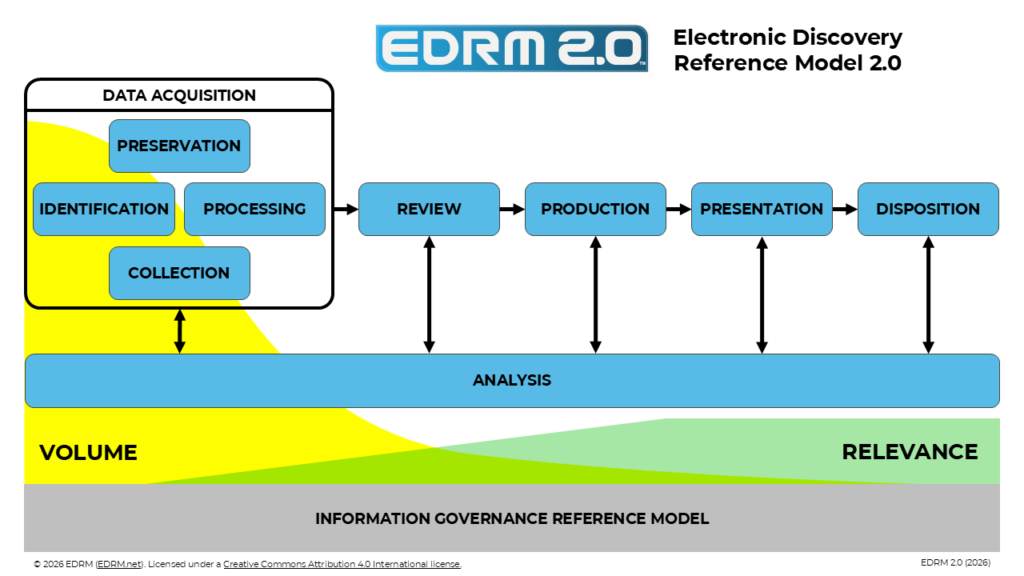

Conceived in 2005, the Electronic Discovery Reference Model (EDRM) became the north star of eDiscovery. It functions as a map for practitioners working through the muddy waters of discovery and a blueprint for vendors to build their products against. The key value it provides is connecting process and product and providing a standardized vocabulary to ensure the whole ecosystem speaks the same language.
But like any language, after years of use it's evolved into something slightly different. And like the dictionary, which is regularly updated with new words – doomscrolling and humblebrag made it into the Oxford dictionary this year – the EDRM was due for an update.
On September 1st, 2026, the EDRM organization released EDRM 2.0, the model's first major update since it absorbed the Information Governance Reference Model (IGRM). It stands as a representation of how eDiscovery has developed in the last 20 years and where it's headed next.
What's New in the EDRM 2.0
Here's a quick summary of the biggest changes in the model:
- Identification, preservation, collection, and processing are now grouped under the “Data Acquisition” step.
- Disposition has been added as a concrete step at the end of the workflow.
- Information Governance sits as a foundation layer
- Analysis has moved from a single discrete step between review and production to a continuous step that spans every phase.
- The volume-vs-relevance graph now reflects a new reality: more data, but smarter tools to sort through it.
But what do these changes mean? How do they affect practitioners, their processes, and the products they use? Here's what stands out to us.
Continuous Analysis
The repositioning of analysis is the most substantial change in the model. Rather than analysis sitting as a discrete phase, it runs as the connective tissue across the entire process. In the press release, the EDRM organization stated that this change reflects the "growing role of legal judgment, analytics, data science, and AI throughout the lifecycle."
The updated model reinforces the value of continuity across the discovery lifecycle. The insight for corporate legal teams isn't that every capability needs to live in one application, but that the tools supporting each stage need to work together without creating unnecessary gaps and handoffs.
Further, legal teams increasingly leverage AI for analysis. Aligned with the 2.0 model, the implementation of AI in eDiscovery looks like an AI layer that runs across the full workflow. It works to make sure there are no gaps to stitch together, ensuring the context from one stage travels with the data into the next, rather than being reconstructed each time.
Ultimately, weaving analysis through the workflow makes the case for a connected ecosystem of legal tools with AI woven through every stage.
The Volume Cliff
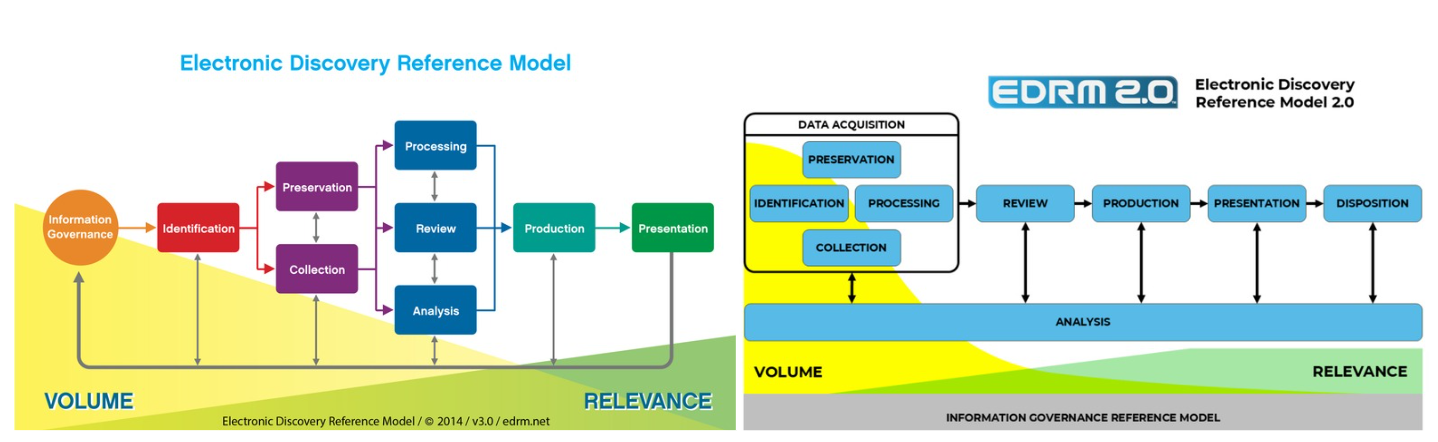
If you line up the two models, you'll notice that the volume vs. relevance relationship in the background has been redrawn, reflecting the volume of data that corporate eDiscovery manages.
Corporate eDiscovery operations now start the data acquisition phase with terabytes of Slack data, hundreds of recorded Zoom meetings, and GBs of sprawling emails. So, to control costs and save time, they need eDiscovery platforms with the culling capabilities to quickly whittle it down.
The model reflects this reality. Data volumes start higher, technology culls large percentages of irrelevant data earlier and more quickly, and a tightly scoped dataset gets pushed to review.
Specialized Capabilities Still Matter
In a moment where AI lumps process together, it's worth noting what EDRM 2.0 keeps distinct. Data Acquisition, Review, Production, Presentation, and Disposition still sit as their own distinct phases. This differentiation highlights the specialized capabilities each stage requires.
During data acquisition, you need defensible preservation and detailed audit trails, collection ability from modern enterprise data sources, and processing abilities that cull the data and organize it into a reviewable set.
During review, you need intuitive features, batching and tagging features, clean redactions, AI-powered search capabilities, and the ability to work strategically as a team within one review project.
During production, you need specific formats, templates, Bates-numbering, and the ability to get the right access to the right people in the right format.
And so on.
So, in your legal technology, you need the strongest capability at each phase working within a connected workflow.
Where EDRM 2.0 Leaves Us
EDRM 2.0 isn't a cosmetic refresh. The new model recognizes how the processes and products that make up eDiscovery have changed since 2005.
And what we are taking away is that this new era of the EDRM is defined by a connected workflow, where you get the right capability at every stage. That's the model Logikcull's corporate discovery suite supports today. It is an eDiscovery solution that gives corporate legal teams defensible collection, fast culling, and AI-powered review in one connected eDiscovery suite, as EDRM 2.0 envisions.
Learning With Logikcull
Browse our latest resources for innovative legal teams like yours




Stay in the know
Get the latest news, expert guidance, and interviews delivered straight to your inbox so you're always one step ahead.
Get the latest updates
Want to see it work?
Request a demo today.
Managing FOIA requests with limited staff, strict deadlines, and pressure to protect sensitive data?
Logikcull is built for this.