
More People Are Asking. Fewer People Are Answering.
A look at FY2025’s record demand for public records and the shrinking federal workforce racing to answer them.



During the 2025 fiscal year, the federal government received 1,707,197 FOIA requests, approximately 14% more than FY2024's 1,501,432.
Let's put that scale into perspective. 1.7 million requests means:
- A new request lands every 18 seconds.
- Nearly 4,700 requests a day, every day, (even on holidays and weekends.)
- If every request were a single sheet of paper and you stacked them all up, they'd stand about as tall as the Washington Monument.
- If every requester were unique, you could sell out an NFL stadium about 24 times over.
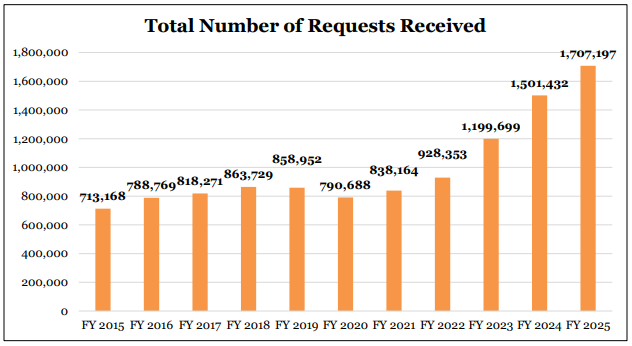
The headline here is that the 1.7 million requests are up approximately 14% from the prior fiscal year, an increase of 205,700 requests. That increase alone added roughly seven stories' worth of paper to the stack and the ability to fill three more stadiums with requesters.
FOIA officials attribute the spike to artificial intelligence easing the barrier to submitting requests, mass submissions from political organizations, and an uptick in immigration-related requests.
Fewer Hands, More Requests
While requests have climbed at record rates since 2020, the number of full-time FOIA staff at the federal level has fluctuated, mostly dipping, since then. After dipping from FY2020 to FY2023, it jumped to an all-time high in FY2024, then dropped sharply again this last fiscal year.
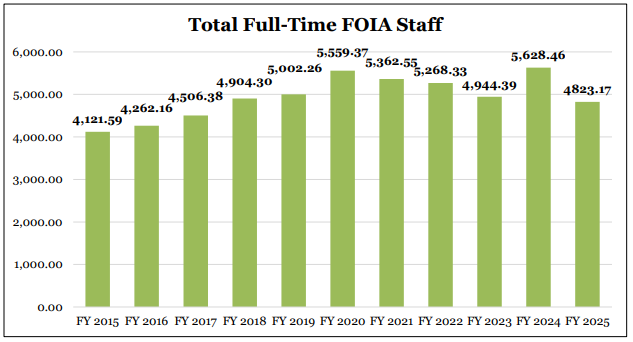
Between FY2024 and FY2025, full-time FOIA staff decreased 14.3%, which, paired with a 14% increase in requests, means agencies are being squeezed by an increase in volume and a decrease in labor resources.
This has left agencies with a record backlog of 339,671 requests, 27% up from the end of the previous fiscal year.

And this only captures the federal level.
The Pressure Isn't Just Federal
State and local agencies are seeing the same pressure, with fewer resources. In a survey of 240 state, county, and city agencies, Granicus found that request volume climbed 161%, while the complexity of those requests rose by 72%. Generally, request file sizes are larger and increasingly include video, such as surveillance and body-cam footage, so processing time per request continues to grow.
The City of Corona now processes between 80 and 120 requests a month, a 200% increase from six years ago, while headcount hasn't changed. Fairfax County reports a similar 200% surge in FOIA requests for email records, with every month setting a new record for request volume.
Across government and educational systems in the United States, the volume and complexity of FOIA requests continue to grow, with no signs of slowing. Meanwhile, FOIA teams' resources keep shrinking. At this rate, the gap between request volume and fulfillment resources will become a chasm that threatens government transparency, public trust, journalism, and democracy overall.
Where Does That Leave Us?
It's not all gloom and doom. Agencies are finding creative ways to respond to requesters while prioritizing public trust. Many teams turn to tools that streamline, automate, and centralize the most difficult parts of the records request process.
When the City of Corona implemented Logikcull for Public Records, they sped up collection, review, and production sixfold and reviewed 500% more documents per hour. When Fairfax County implemented Logikcull for Public Records, they reduced document volume by 67% and turned around 90% of email record collections in under an hour.
When a request flies in every 18 seconds, it doesn't have to feel like a Washington Monument-sized backlog is crashing down on your team. You can run a workflow, that's manageable for the people running it, and still gets information to the people who requested it.
Learning With Logikcull
Browse our latest resources for innovative legal teams like yours




Stay in the know
Get the latest news, expert guidance, and interviews delivered straight to your inbox so you're always one step ahead.
Get the latest updates
Want to see it work?
Request a demo today.
Managing FOIA requests with limited staff, strict deadlines, and pressure to protect sensitive data?
Logikcull is built for this.