
No Boilerplate Objections: Parties Need to Explain Withheld Documents on a Privilege Log
Avoid boilerplate objections in eDiscovery. Learn privilege log requirements, key ESI metadata, and how Logikcull helps legal teams document withheld data.

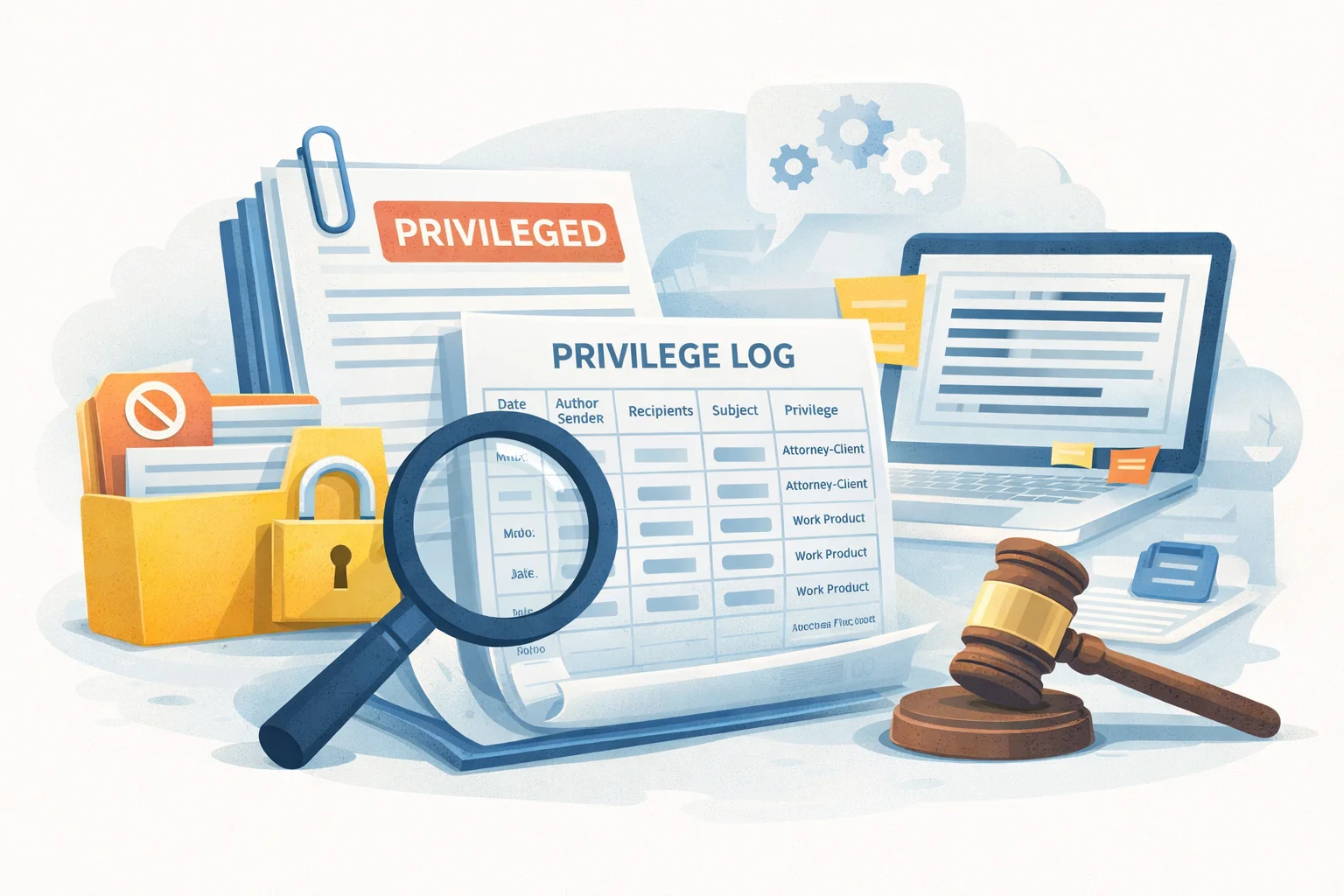

In litigation in both U.S. Federal District Courts and across all 50 states, the rules for withholding documents based on objections are consistent: an objection must be clearly stated, with the basis for the objection explained on a privilege log. The privilege log must contain enough information for the requesting party to evaluate the claimed privilege without disclosing the privileged information. In the age of email and text messages, that includes metadata fields custodian, MD5 hash value, to, from, cc, date sent and/or received, and possibly the subject line. Subject lines can disclose a privilege, so there may be good reasons not to include them.
In a New York discrimination lawsuit, the defendants sought electronically stored information in discovery requests based on the plaintiff's deposition discussion of the alleged discrimination. The plaintiff responded with boilerplate objections to 31 of the 32 discovery requests. Moreover, the plaintiff did not provide a privilege log or identify whether any responsive materials were withheld. Alexander v. N.Y.C. Health, 2025 NY Slip Op 34958(U), 2 and 3 (Sup. Ct.)
Judge Hasa Kingo recounted that discovery objections must be specific and tailored. Moreover, objections are not a substitute for substantive compliance. Judge Kingo stated, “A party who objects must still, at a minimum, identify what is being withheld on the basis of the objection and, where privilege is claimed, provide an adequate privilege log—so that the opposing party and the court can evaluate the claim without guesswork.” Alexander, at *3.
The court ordered the following:
- The plaintiff had to state for each discovery request whether there was responsive ESI for production;
- The plaintiff had to identify which produced documents or ESI were responsive to specific requests for production by Bates number;
- Documents or ESI withheld on the basis of privilege needed to be disclosed; and
- A privilege log had to be produced that would allow the requesting party to assess the claimed privilege with date, author, recipients, general subject matter, privilege asserted, and the request(s) to which the withheld item is responsive.
Logikcull Insight
Drafting privilege logs requires attorney skill and the effective use of custom fields to efficiently identify withheld records and the basis for their non-production.
Parties need to identify 1) documents that are withheld on the basis of privilege; 2) a privilege explanation that allows the requesting party to assess the claimed privilege; and 3) the corresponding request for production that the document is responsive to.
A privilege log also needs objective data from the four corners of the document, which includes who sent the communication, who it was sent to, and other descriptive information. Exporting metadata can meet this obligation.
Producing parties can create privilege logs in Logikcull by exporting issue coding, metadata, and a privilege explanation as a CSV.
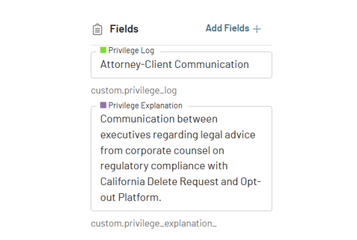
One option for designating a privilege and “privilege explanation” is to use two custom fields. This empowers the attorney to identify the privilege and explains the rationale for claiming it, thereby justifying withholding the document from production.
A privilege log can be created by exporting the required metadata, issue coding, and privilege explanations to a CSV file.
The CSV can be modified as necessary to comply with the legal requirements for a privilege log. Attorneys can review and revise the draft log as necessary to comply with the legal requirements for producing a privilege log. Revisions can include column names and fine-tuning privilege descriptions.

Requirements for privilege logs are consistent across the country. There can be variations based on state law or local rules. However, some judges are encouraging parties to use privilege logs with metadata, Gen AI, and other innovative approaches. Logikcull can help attorneys meet the traditional requirements of privilege logs and creative approaches to defending privileged information.
Learning With Logikcull
Browse our latest resources for innovative legal teams like yours




Stay in the know
Get the latest news, expert guidance, and interviews delivered straight to your inbox so you're always one step ahead.
Get the latest updates
Want to see it work?
Request a demo today.
Managing FOIA requests with limited staff, strict deadlines, and pressure to protect sensitive data?
Logikcull is built for this.