
Court-Ordered Unredacted Documents for Deposition
The Deposition Was Days Away. Then a Former Employer Filed an Emergency Motion to Unredact.



An employer sued a former employee after they joined a competing company. The lawsuit included claims of breach of contract and breach of the duty of loyalty. The employer sought early discovery from the former employee, including communications from a personal email account. Frontdoor, Inc. v. Kluver, No. 2:25-cv-02533-STA, 2025 U.S. Dist. LEXIS 206524, at *3-4 (W.D. Tenn. June 12, 2025).
The defendant produced 254 pages of records, with redactions on 53 of them. The defendant argued that the redactions were over irrelevant information. The plaintiff brought an emergency motion to compel the production of unredacted copies of the documents. The Plaintiff filed under seal 14 of the reacted pages with the court in support of its motion. The redacted documents contained communications with unknown individuals. Frontdoor, at *9-10. After the moving papers were submitted to the court, the court had only 24 hours to rule on the issue before the defendant's deposition. Frontdoor, at *4-5; 10-11.
That is not an ideal situation for a judge to make an all-or-nothing decision on redactions.
To Redact or Not to Redact Irrelevant Information
There is a split of authority between the Federal District Courts on redacting irrelevant information.
Courts in the Sixth Circuit have held that parties "cannot unilaterally redact portions of documents based on relevancy grounds." Frontdoor, at *11, citing Melchior v. Hilite Int'l, Inc., No. 13-50177, 2013 U.S. Dist. LEXIS 71393, at *3 (E.D. Mich. May 21, 2013).
The rationale for not redacting irrelevant information is based on the Federal Rules of Civil Procedure: Irrelevance is not a privilege. Frontdoor, at *11, citing Medtronic Sofamor Danek, Inc. v. Michelson, No. 01-2373-GV, 2002 U.S. Dist. LEXIS 27981, at *5 (W.D. Tenn. Jan. 30, 2002).
On the other hand, redacting irrelevant information can be appropriate if there is a “protective order to regulate the use and circulation of sensitive information and the protective order is not sufficient to protect the confidentiality of irrelevant information.” Frontdoor, at *11-12, citing Osborn v. Griffin, No. CV 11-89-WOB-CJS, 2013 WL 12176851, at *7 (E.D. Ky. July 17, 2013).
Court’s Ruling on Redactions
The court ruled that the redactions of irrelevant information were not proper. The defendant had to produce the 53 pages without redactions before the defendant’s deposition. Frontdoor, at *12-13.
The redactions were ⅕ of the production. Moreover, it was not possible to draw any conclusions from the context of the communications from many of the redacted pages. Id.
Despite the order to produce the unredacted pages, the court stated the communications could contain confidential information that individuals would want to keep private. The court expressed surprise over the parties not seeking a protective order. The court cautioned the parties on discretion and to safeguard the privacy interests of third parties. Frontdoor, at *13-14.
Logikcull Insight
Redactions are applied because there is information that is privileged, confidential, or personal identifiable information protected by privacy laws.

Privileged information includes the traditional privileges of attorney-client communications, spousal communications, medical, clergy, and related state privileges.
Confidential information can be anything from trade secrets to information protected by non-disclosure agreements.
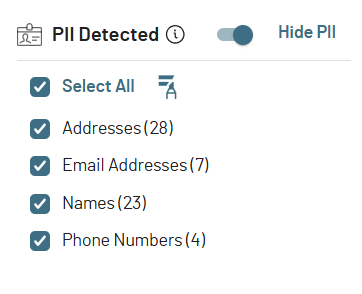
Personal identifiable information is information that contains names, email addresses, phone numbers, social security numbers, credit cards, medical information, and related information protected by privacy laws.
Redactions exist to protect privileged and confidential information from disclosure. Logikcull can automatically identify personal identifiable information. Upon review of the PII, redactions can be applied with a text overlay detailing the reason for the redaction.
Knowing where to apply redactions takes legal skill and analysis. Logikcull can help automate that process once protected information is identified before producing any records. This way, you can avoid the mess this defendant got themselves into.
Learning With Logikcull
Browse our latest resources for innovative legal teams like yours




Stay in the know
Get the latest news, expert guidance, and interviews delivered straight to your inbox so you're always one step ahead.
Get the latest updates
Want to see it work?
Request a demo today.
Managing FOIA requests with limited staff, strict deadlines, and pressure to protect sensitive data?
Logikcull is built for this.