
Run From Intake to Disclosure With the Right Public Records Request Software
The clock starts the second a request lands. See how the right public records request software carries FOIA and open records requests from intake to disclosure, so your team never misses a deadline.



The moment a citizen submits a public records request, the clock starts. And to fulfill the request beforetime runs out, teams need the right tool. Public records request software gives government and education teams a centralized system to take in requests, pull and search responsive records, redact sensitive data, and release everything before the statutory deadline. It replaces the usual patchwork of email, spreadsheets, and manual PDF redaction with a single trackable workflow that runs to completion before time runs out.
What is public records request software?
Public records request software is a platform that manages the full lifecycle of a Freedom of Information Act (FOIA) or state public records request. It runs from intake through search, review, and redaction, to disclosure within one platform. Traditionally, this workflow spreads across tools: you capture responses through a form, manually pull emails from Outlook, redact in Adobe, and produce over email. A centralized platform gathers these disparate steps and replaces them with one trackable, deadline-aware tool.
Some teams call it public records software, open records request software, or FOIA software. The label shifts with the jurisdiction, but the workflow stays consistent.
Why records teams are drowning in requests
Records requests from residents, journalists, attorneys, and commercial requesters are climbing, yet the teams answering them rarely grow at the same pace. Federal FOIA requests topped 1.5 million in fiscal year 2024, a 25% jump in a single year, and state and local agencies feel the same pressure.
The deadlines, meanwhile, stay fixed. Federal FOIA generally requires an agency to respond within 20 business days, and public records laws vary by state, often running on shorter timelines than federal requests. Every missed deadline risks appeals, lawsuits, and unwanted headlines, all things that sap public trust.
What Public Records Request Software Should Do
Think of a well-run restaurant, whether it's your local McDonald's or a Michelin-star kitchen. Most restaurants run like oiled machines. Orders come in through tickets, move through a systemized kitchen, and go out plated the same way every time, whether it's a slow Tuesday or the lunch rush. Good public records request software brings that same centralized intake and repeatable process to records work. In both cases, the system is built to withstand a surge.
Here is what that looks like across the lifecycle of a request:
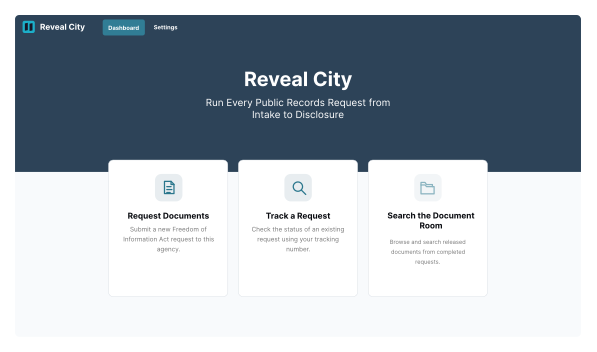
- Intake: A requester submits a FOIA or public records request through a branded, public-facing portal that takes in and tracks every request in one place, with configurable forms and templated status updates.
- Preserve & collect: Direct connectors to Microsoft 365 and Google Vault auto-ingest records, and drag-and-drop handles everything else.
- Search & cull: Automatic deduplication, email threading, and full-text search cut the volume, while natural-language search surfaces key documents.
- Review & redact: Automated detection of personally identifiable information (PII) flags SSNs, addresses, and names, and bulk redaction covers them without page-by-page work in Adobe.
- Produce & publish: Produce in any format, publish back to the requester through the portal, and track the whole thing against its statutory deadline.
All of these steps live within the same tool, making the work easier to do and easier to keep track of.
Where records teams get stuck
It's Friday at 3 p.m. A response is due by end of day, but the redaction tool keeps crashing on a 400-page PDF, and the email export you pulled is a tangle of duplicates and broken threads. So you're re-redacting the same pages by hand and copying deadline dates into a spreadsheet to keep track. Sweat drips down your forehead as you muscle through, hoping to make the deadline amid all these obstacles.
In most cases, request-related delays aren't about a lack of effort. They come from mis-tooling that leaves no clean way to keep every request moving. A purpose-built platform helps by centralizing the data, automating the tedious parts, and keeping deadlines trackable.
Things your public records software should include
- A public-facing, agency-branded intake portal where requesters submit and track their own requests
- Direct connectors to your systems of record (Microsoft 365 and Google Vault), plus drag-and-drop for everything else
- Automatic deduplication, email threading, and full-text search across all uploaded data
- Automated PII detection and bulk redaction, so sensitive data is caught before release
- Deadline tracking with automatic reminders against each request's statutory clock
- Production in any format and one-click publishing back to the requester
- Enterprise-grade security (SOC 2 Type II, HIPAA) with granular access controls and audit trails
- Self-service setup, so a request can be underway in minutes with no IT project or vendor intervention
- One workflow that handles FOIA, state public records acts, and education records requests
What you need to know
In short, public records request software runs the entire request lifecycle, from intake all the way to disclosure. These platforms streamline the workflow with automated PII detection and redaction, deadline tracking, direct integrations, and GenAI search tools like ASK. The result: teams get what they need to respond effectively, and the system scales with the volume of requests, so a busy week doesn't become a backlog.
Frequently asked questions
What is the difference between public records request software and eDiscovery software?
They share the same engine. Public records request software applies eDiscovery-grade search, review, and redaction to FOIA and open records work, then adds a requester intake portal and statutory deadline tracking built for high-frequency requests.
How does public records request software help agencies meet FOIA deadlines?
It tracks every request against its statutory deadline with automatic reminders, while speeding the work in between with automated search, PII detection, and bulk redaction so nothing waits on manual steps.
Can one platform handle both FOIA and state public records requests?
Yes. A good platform manages federal FOIA, state public records acts, and education records requests in the same workflow, because the underlying steps of intake, search, redaction, and release are the same.
Does public records request software redact PII automatically?
Leading tools automatically detect PII such as Social Security numbers, addresses, phone numbers, and names, then let you apply redactions in bulk rather than one page at a time.
Do you need IT to set up public records request software?
Not with a self-service platform. Teams can stand up a branded portal and start a request in minutes, with no IT project or vendor onboarding.
Is public records request software the same as FOIA software?
They describe the same category. “FOIA software” emphasizes federal requests, while “public records request software” also covers state and local open records laws. Most agencies need one tool that does both.
Logikcull is the AI-powered eDiscovery and public records response platform built for the high-frequency requests agencies face every day. Essential to 1,500+ organizations including the largest state and local government agencies, higher education institutions, and school districts, Logikcull lets customers kick off responses in seconds, find critical documents in minutes, and predict spend to the penny, all with drag-and-drop ease. That means you never miss another FOIA or PRA deadline.
Learning With Logikcull
Browse our latest resources for innovative legal teams like yours



Stay in the know
Get the latest news, expert guidance, and interviews delivered straight to your inbox so you're always one step ahead.
Get the latest updates
Want to see it work?
Request a demo today.
Managing FOIA requests with limited staff, strict deadlines, and pressure to protect sensitive data?
Logikcull is built for this.