

Motion to Compel Review and Production of 3,200 Search Term Hits
Think 3,200 Search Term Hits Is Too Many to Produce? A Court Disagrees.



3,200 Records to Review Are Not Unduly Burdensome
Discovery fights over the production of ESI responsive to search terms are common. In Valve Corp. v. Rothschild, the plaintiff (Valve Corporation) sought the production of ESI responsive to search terms that would ultimately generate 3,000 records from just three email custodians. The defendants refused to produce the email, and motion practice followed. Valve Corp. v. Rothschild, No. 23-cv-1016, 2025 U.S. Dist. LEXIS 255847, at *3, 6-7 (W.D. Wash. Dec. 10, 2025).
United States District Judge Jamal N. Whitehead deemed the search terms relevant to the case and ordered the defendants to review and produce the responsive documents. The plaintiffs sought search terms relevant to the claims of a patent infringement case and to the issue of whether the defendants had engaged in a pattern of asserting patent infringement. Valve, at *7-8.
The search terms also addressed whether the defendants had discussed settlement terms in any alleged patent infringement claims. Id.
Judge Whitehead stated that reviewing less than 3,200 records was neither onerous nor burdensome, especially in light of the unrebutted argument that the unique hit count of records was actually lower than 3,200. Id.
Logikcull Insight
Requesting parties have been stating search terms for producing parties to run for years. This is nothing new. What also is not new is that the producing party gets to review any hits for responsiveness and privilege before production. Just because an email is a hit to a search term does not mean it is responsive to the request for production, let alone relevant to the case.
Running search terms in Logikcull is a straightforward process. If a request for production has a list of search terms, those can be entered as a bulk search.
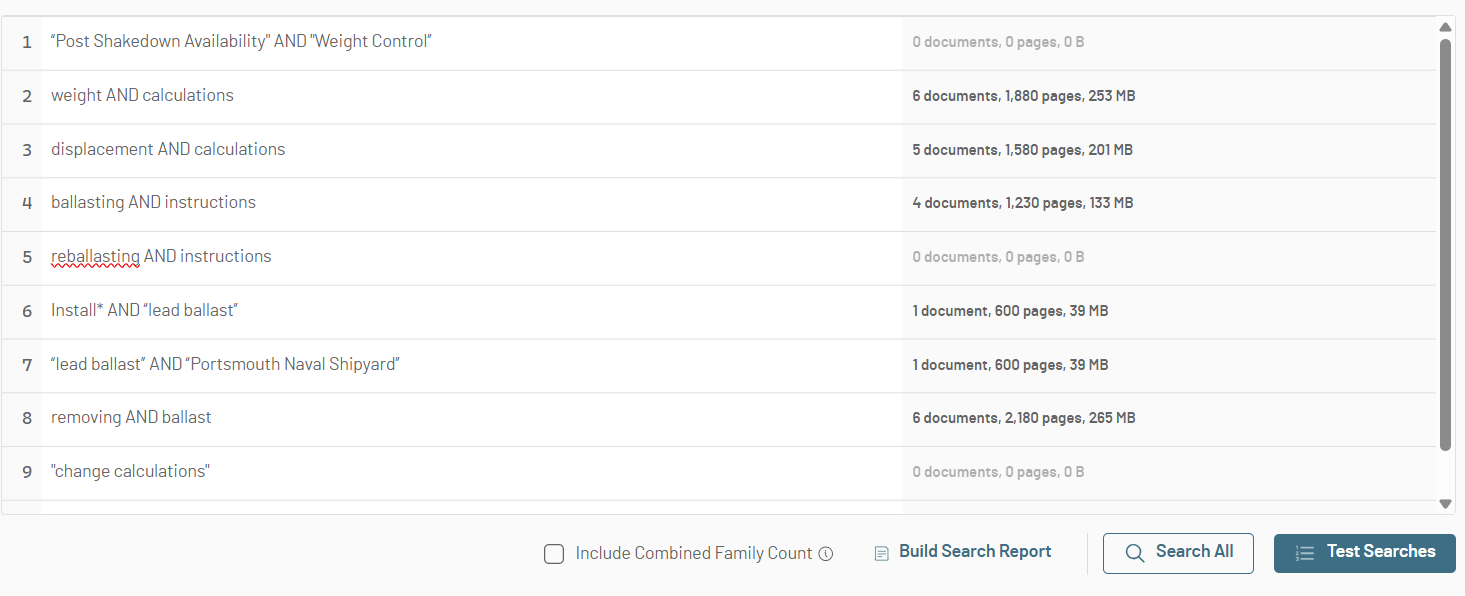
When the requesting party sets specific search terms, it leaves a certain amount of risk, as you can’t refine the terms. So another approach is to use search concepts, which allows for more refinement.
There are multiple ways to approach running search terms: One strategy is to use Boolean Operators to find keywords with the connectors AND, OR, and NOT. Examples include “normal AND levels”, “normal OR levels”, and “normal NOT levels.” This allows the reviewer to conduct initial searches for how terms can appear in possibly relevant documents.
Proximity searches can find terms within a defined distance from each other, such as
(normal levels)~10.

Where a Boolean “AND” search can be very broad, finding two words within a set distance allows for more precise searches.
Search is a process of trial and error. Bulk search terms can work with very defined keywords. However, a workflow that allows a review team to learn from different searches, enables a review team to zero in on relevant documents for discovery responses, exhibits for depositions, or supporting evidence for dispositive motions.
Learning With Logikcull
Browse our latest resources for innovative legal teams like yours




Stay in the know
Get the latest news, expert guidance, and interviews delivered straight to your inbox so you're always one step ahead.
Get the latest updates
Want to see it work?
Request a demo today.
Managing FOIA requests with limited staff, strict deadlines, and pressure to protect sensitive data?
Logikcull is built for this.