
The CLOUD Act in Europe: How Logikcull Manages Public-Sector Data, Sovereignty, and Lawful Access
Learn how the U.S. CLOUD Act affects EU public-sector data and how Logikcull ensures data sovereignty, lawful access, and compliance in Europe.

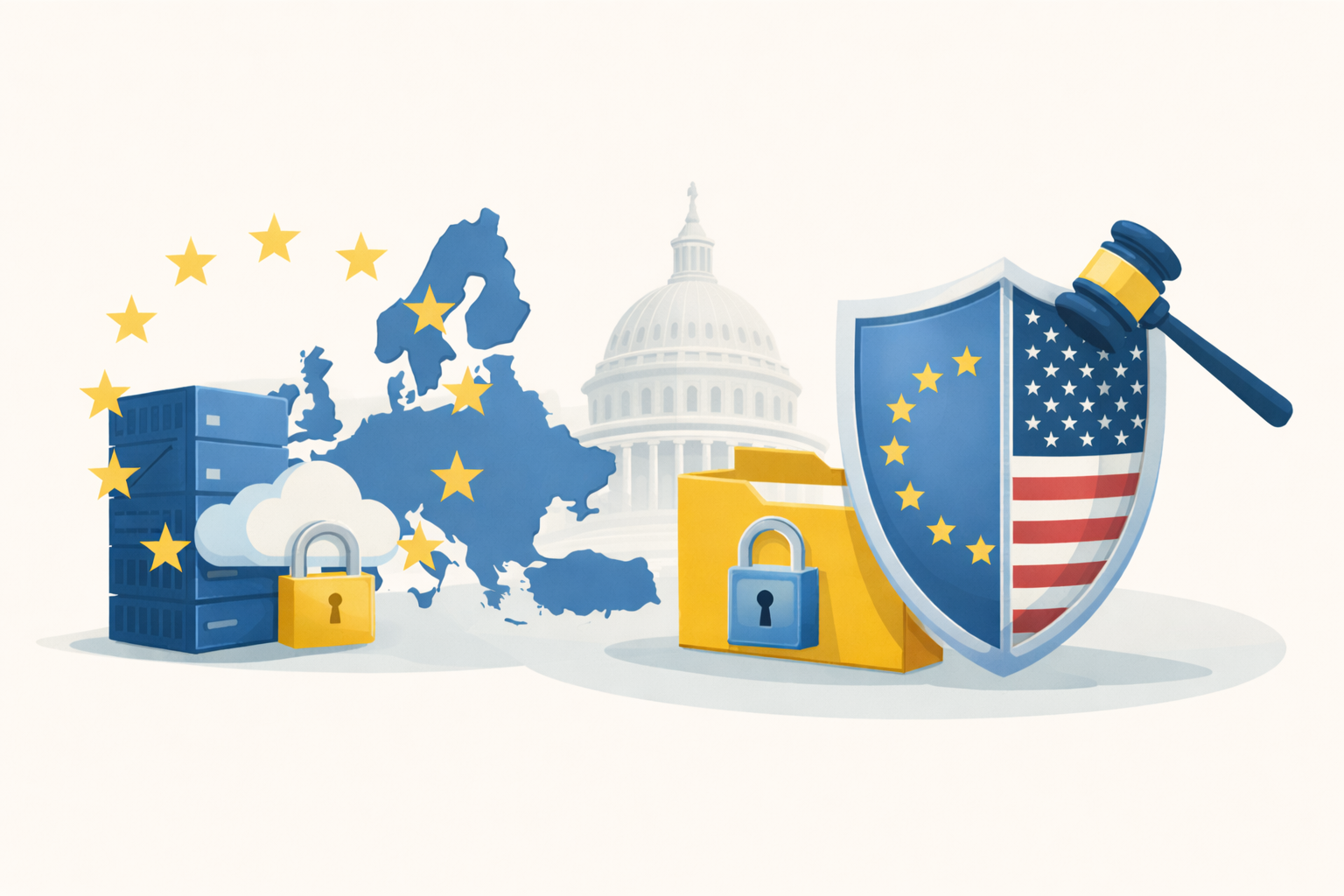

Imagine lending your diary to a friend for safekeeping. You trust them with your most private thoughts, but there's a catch: your friend lives in a different country with different laws. If their government knocked on their door with a warrant, could they hand over your diary without asking you first? Would you even know it happened?
This is essentially the dilemma facing EU and UK public-sector organizations today. As government agencies move sensitive data to EU based cloud platforms own by US companies they're grappling with a modern version of this trust paradox. The diary is now terabytes of citizen data, investigation files, and classified documents. The friend is a SaaS provider. And the knock at the door? That's the U.S. CLOUD Act.
Introduction
In a previous article, we examined the U.S. CLOUD Act, debunked common myths surrounding it, explored why misconceptions persist, and identified safeguards that help mitigate associated risks. In this article, we'll examine what these realities mean for EU and UK public-sector organizations using EU based SaaS platforms for discovery and investigations.
The concerns surrounding the U.S. CLOUD Act typically center on three key areas: data sovereignty, access controls, and lawful-access procedures. These concerns are particularly significant for government bodies, as they directly impact national security, public trust, and legal accountability in ways that differ from private-sector considerations.
Data sovereignty ties directly to national security and digital independence. It ensures that data is subject to the laws of the country where it is stored, which is essential for protection against espionage, safeguarding digital infrastructure that enables vital government programs (such as healthcare), and managing risks related to international conflicts.
Access controls are key to maintaining public trust. They protect intellectual property, maintain the integrity of public records, and prevent misuse of citizens' data. Think of it like trusting someone with a secret. If they spill it to everyone without your permission, you immediately lose trust and won't confide in them again. Public trust in government operates the same way. When governments mishandle personal data, public trust erodes, potentially leading to civil unrest.
Lawful access ensures accountability and safety. It refers to the legal framework law enforcement must navigate to obtain evidence for investigations, balancing privacy rights with the government's duty to protect the public.
As eDiscovery shifts toward cloud-first systems that often operate across borders, clarity around data sovereignty, access controls, and lawful access becomes essential. As discussed in our previous article, it's critical to separate myth from reality regarding cross-border data access.
Key Takeaways from Our Previous Article
- The U.S. CLOUD Act does not allow the U.S. government unrestricted access to data worldwide. Strict requirements and processes govern data access.
- The CLOUD Act does not permit general surveillance; it is limited to specific criminal investigation-based requests.
- European data stored in U.S. & EU cloud services is not automatically exposed to U.S. authorities. The Act's request framework, along with encryption protections, helps safeguard against exposure.
- U.S. cloud providers aren't inherently risky for the EU public sector, as they must still comply with EU compliance frameworks.
What the CLOUD Act Really Means for SaaS Providers
The Clarifying Lawful Overseas Use of Data (CLOUD) Act is a U.S. federal law passed in 2018. It establishes a legal framework that cloud providers must follow when U.S. law enforcement requests data from their servers, regardless of where that data is stored globally. The Act applies to U.S. companies under U.S. jurisdiction and, like all legal requests for information under U.S. law, requires valid warrants, subpoenas, or court orders.
Contrary to popular belief, it does not provide the U.S. government with unfettered access to foreign or governmental data. Data requests must be limited to investigations into serious criminal offenses such as terrorism, child exploitation, cybercrime, or narcotics trafficking. Additionally, when data providers receive a request, the Act allows them to challenge it, seek clarification, or reject it if it conflicts with EU law.
Because of these protections, data hosting location can influence how companies respond to requests based on applicable national laws, the feasibility of accessing the data, and data service providers' regulations and privacy policies.
How Modern Legal-Tech Platforms Engineer Strong Data Protection
Modern legal-tech platforms are built with data sovereignty, access controls, and lawful access in mind. Let's examine Logikcull as an example. Logikcull is a cloud-based eDiscovery platform that helps legal teams collect, identify, and review electronically stored information. Its servers host a wide range of data, including privileged and PII information that must remain secure for the corporations, governments, and law firms that use the platform, as well as for their customers and employees whose data may be hosted within it.
Five Key Components of Logikcull's Data Protection
1. Data Encryption
In Logikcull, customer data is encrypted both in transit and at rest. Data encryption in transit protects information as it travels across networks. Logikcull uses Secure Sockets Layer (SSL) protocol for any information transmitted between users, parties, and the platform through encrypted channels. This encryption process generally follows three steps:
- Secure handshake: A client and server initially exchange cryptographic keys and agree on encryption methods
- Encryption: Once the secure channel is established, data is automatically encrypted before leaving the source
- Decryption: Once data is received, it is decrypted and verified to ensure it hasn't been altered
It's like passing notes in school: you and your friend shake on a secret code, translate your message into that code, pass a folded-up piece of paper across the classroom, and your friend receives it and decodes it. This version is far more secure but follows the same basic logic.
Data at rest refers to information stored on a device that isn't actively moving or being processed. This data is just as important to protect because it can be a prime target for hackers. Logikcull safeguards this information by using 256-bit AES encryption for all data stored within its private cloud. This highly secure, symmetric encryption standard uses a 256-bit key to scramble data into unreadable text. It's widely used by governments and banks, is considered the most secure encryption algorithm available today, and is virtually uncrackable.
2. Lawful-Access Provisions
Logikcull, like many cloud providers, has oriented its data storage so that the provider cannot access customer content without explicit customer authorization. For example, Logikcull can detect that data is stored in the cloud and track how much data is hosted (usually for billing purposes), but cannot see what specific data is stored, nor can it access specific email chains or PII.
3. Zero-Standing-Access Policies
Zero-standing-access (ZSA) policies mitigate the risk of permanent admin or privileged access by granting collaborators temporary, just-in-time access. Stakeholders receive only the access they need for specific tasks, which is then automatically revoked. Think of it like a hotel: guests receive key card access to their room for the duration of their stay, and the hotel immediately revokes that access when they check out.
Logikcull implements ZSA policies to protect customer data while maintaining its integrity as a collaborative eDiscovery platform. For example, collaborators can be designated as limited users, restricting them from creating new projects and giving them access only to assigned projects. This access can be revoked at any time.
4. Architecture Design
Logikcull's architecture is designed so that plaintext customer data is shielded from unilateral disclosure. This means the platform is built to prevent Logikcull as the provider from viewing or sharing a customer's raw, readable data. In the case of a law enforcement request under the U.S. CLOUD Act, Logikcull cannot see customer data and therefore has no way to determine what's relevant or share it, thus preventing unilateral disclosure.
5. Workspace Isolation
Workspace isolation is a cybersecurity strategy that creates separate digital environments for specific tasks, projects, or users. It reduces exposure because if one workspace is compromised by malware, the threat is contained and cannot spread to other parts of the system. Logikcull uses this strategy to help protect data.
Understanding Logikcull's Role in Government Data Access Requests
While Logikcull has extensive security measures in place, it is a U.S.-based company under U.S. federal jurisdiction and therefore subject to the U.S. CLOUD Act. Let's examine Logikcull's process for handling cross-border data requests, such as those allowed under the CLOUD Act.
Standard Process
Logikcull in Europe operates on AWS (Amazon Web Services) infrastructure, hosted in their Frankfurt data center. As such, Logikcull acts solely as a data processor, not a data owner. Logikcull's Terms of Service and privacy documentation clarify that customers control their hosted data, and Logikcull only processes such data on behalf of the customer under their instructions. This is consistent with GDPR controller-processor frameworks.
Logikcull does not host personal accounts, email inboxes, or structured datasets tied to identifiable individuals. Instead, the platform stores general customer uploads, often evidence or FOIA-related materials connected to government or political decision-making. While internal to a project Logikcull’s Personal Identity Identification (PII) detection feature can help locate fragments of personal data, the architecture design prevents Logikcull as the processor from identifying, tracking, or searching for personal data across its systems.
These uploads may contain fragments of personal data relevant to a legal matter, but due to the architecture design discussed earlier, from the processor side Logikcull cannot identify, track, or search for personal data across its systems. Yet internal to a project (into which Logikcull as the processor cannot see there) is a Personal Identity Information (PII) detection feature that flag this data for the purpose of document review.
Logikcull cannot identify, track, or search for personal data across its systems.
Because of both AWS hosting and the architecture design, Logikcull does not independently receive or act on government requests targeting personal accounts or individuals. Requests are typically directed at cloud providers such as AWS under U.S. law (including the CLOUD Act), rather than at Logikcull itself.
When cloud providers like AWS receive a legal request, the provider must first validate that the request is legally binding, properly scoped, and compliant with applicable law, considering potential conflicts with the GDPR or other applicable data-protection laws.
Transparency to Customers
Both Logikcull and AWS maintain clear customer transparency practices. When legally permissible, providers endeavor to notify customers of requests for data. Many large cloud providers publish transparency reports summarizing governmental data demands and compliance.
How Logikcull Meets EU Public-Sector Compliance Expectations
Now that we understand how Logikcull interacts with the CLOUD Act and maintains accountability through transparency practices, let's clarify that these processes don't impede Logikcull from meeting EU public-sector compliance expectations. Logikcull's technical and procedural safeguards align with the following compliance frameworks:
General Data Protection Regulation (GDPR): The GDPR applies to any organization that offers services to people in the EU. Thus, Logikcull, even as a U.S.-based company, is governed by this regulation as it serves the EU population. Logikcull is committed to complying with the GDPR when dealing with personal data from the European Union, the European Economic Area and their member states, Switzerland, and the United Kingdom. Subject to any exemptions provided by law, individuals may have rights to request access to information, as well as to seek to update, delete, or correct this information.
National Data-Protection Framework: To address the variance in national guidelines surrounding data privacy, Logikcull has certified its compliance with the principles of the EU-U.S. Data Privacy Framework (EU-U.S. DPF) and, as applicable, the UK Extension to the EU-U.S. DPF (UK DPF) and the Swiss-U.S. DPF (Swiss DPF) for transfers of personal data from these respective jurisdictions.
Controller-Processor Boundaries: Data protection law in certain jurisdictions differentiates between the "controller" and the "processor" of information. Within Logikcull, you are the controller of hosted data, and Logikcull is the processor of hosted data and the controller of service data. This is consistent with GDPR controller-processor frameworks.
Public-Sector Requirements: Logikcull meets EU public-sector requirements for due process, auditability, and lawful-access governance.
Sovereignty Considerations: Logikcull has carefully considered the impact of geographical sovereignty when hosting data abroad. Logikcull hosts data in AWS's Frankfurt data center. While physical data residency in EU data centers supports procurement and sovereign cloud expectations, it's important to remember that jurisdiction still follows corporate control under U.S. law, meaning providers with U.S. jurisdiction could be obligated to comply with lawful access requests, regardless of physical location. Yet, physical location gives the cloud provider ability to use local data privacy laws to counter CLOUD Act requests.
Practical Data Sovereignty Measures Available to Customers
Some organizations prefer to take additional protective measures. Logikcull offers practical data sovereignty measures to customers:
- Enforce role-based access internally
- Use encryption controls and limit access to encryption keys
- Maintain detailed audit logs for compliance review
- Apply jurisdiction-aware data residency configurations(where offered)
- Segment matters and restrict access for sensitive or classified content
- Conduct regular security and transparency assessments
Frequently Asked Questions From EU/UK Agencies
Does the CLOUD Act give U.S. authorities direct access to case data?
No, it does not grant direct access to case data. If the U.S. needs to request data from services like Logikcull, the request must focus on serious crime, go through the legal process, obtain a valid warrant or subpoena, and be submitted to data providers. Additionally, Logikcull's architecture is designed so Logikcull cannot read customer data from the backend. Thus, a request for something like PII on a specific case cannot be fulfilled by Logikcull because we cannot read your documents.
Can a provider disclose data without the customer knowing?
In certain circumstances, providers are prohibited from disclosing data requests, allowing them to disclose data without customer knowledge. The notifications of data disclosure subject are subject to the domestic requirements of the issuing country, so the issuing country’s laws govern whether or how notice to an account holder by the provider may be prohibited. This is usually limited to very serious criminal activity where public safety concerns outweigh data protection concerns.
Which types of data does Logikcull host and which does it not host?
Logikcull supports nearly all common file types, including emails, chat messages, documents, spreadsheets, audio files, and video files. It does not host whole disk images, password-protected files, spanned archive files, complex CAD files, or RTF files. Regardless of file type, data is hosted with encryption, with Logikcull as the processor, not the controller, of the data. Yet, in all cases, you have control of what data you choose to upload into Logikcull, the software doesn’t pull data off of your computer at random.
How do EU national regulations interact with a U.S. court order?
The CLOUD Act interacts most directly with the GDPR in the EU. The most significant conflict concerns Article 48 of the GDPR, which prohibits transferring EU data to non-EU authorities solely on the basis of a court order, requiring instead an international agreement (such as a Mutual Legal Assistance Treaty. A U.S. order under the CLOUD Act challenges this article. Accordingly, when a U.S. provider receives a warrant under the CLOUD Act, they may challenge these warrants in U.S. courts, arguing that disclosure would violate EU law (specifically referencing Article 48 of the GDPR).
What happens if encryption prevents the provider from accessing the data?
If encryption prevents the provider from accessing data, the provider generally cannot comply with a CLOUD Act request for that encrypted content, as they lack the decryption key.
How are conflicts of law resolved in practice?
Conflicts of law in international data issues are resolved through a combination of legal doctrines, bilateral and multilateral agreements (like the CLOUD Act), regulatory coordination, and arbitration. There is no one-size-fits-all solution to the conflicts that international data flows create, so countries have access to various safeguards to protect privacy rights and negotiate the nuances between nations.
Conclusion
The CLOUD Act is a narrowly scoped law as opposed to a mechanism for the U.S. to gain mass or warrantless access to EU public-sector data. It is a legal framework to standardize the international data request process. Logikcull, as a SaaS provider based in the U.S. but operating in Europe, falls under the type of company that could receive a CLOUD Act request. However, Logikcull serves only as a data processor; it doesn't directly host or control the data processed through its software. Data in Logikcull is hosted by AWS, and you remain the controller of your data.
Nonetheless, Logikcull ensures data sovereignty and compliance with lawful access requirements. Logikcull's technical architecture, encryption, and strict access controls significantly limit any potential exposure. With clear governance and sovereignty measures like those implemented by Logikcull, EU public-sector customers can confidently use U.S.-based eDiscovery solutions. Keeping your citizens “secrets” safe across jurisdictions.
Learning With Logikcull
Browse our latest resources for innovative legal teams like yours




Stay in the know
Get the latest news, expert guidance, and interviews delivered straight to your inbox so you're always one step ahead.
Get the latest updates
Want to see it work?
Request a demo today.
Managing FOIA requests with limited staff, strict deadlines, and pressure to protect sensitive data?
Logikcull is built for this.